

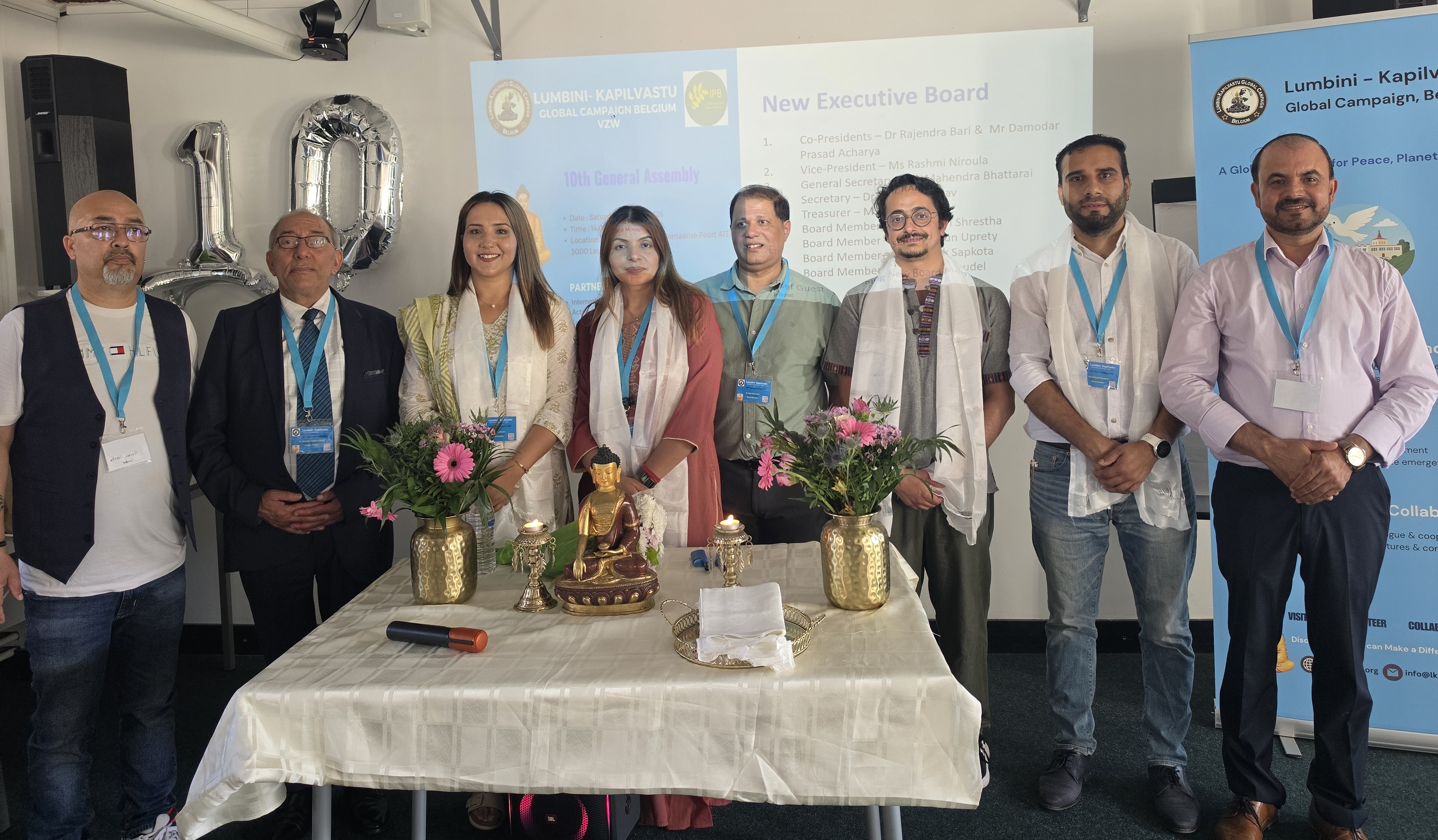
Leuven, June 20 — The Lumbini Kapilvastu Global Campaign Belgium (LKGCB) convened its landmark 10th General Assembly in Leuven, bringing together a diverse gathering of peace-promoting organizations, community leaders, and diplomats to strengthen dialogue, collaboration, and collective commitment toward a more peaceful and harmonious world. Held at Brusselsestraat 63, the Assembly highlighted the importance of unity, shared responsibility, and coordinated action in addressing today’s complex global challenges.
Mindfulness as the Starting Point
The programme began with a guided mindfulness and meditation session led by Mrs. Sabita Dahal, Coordinator and Trainer at Jiwan Bigyan Belgium. Before the formal proceedings, participants were invited into a space of reflection and calm, reinforcing the principle that sustainable peace begins with inner peace.
Welcome and Formal Opening
Ms. Rashmi Niroula, Vice President of LKGCB, opened the event by warmly welcoming all participants at the very beginning of the Assembly. She set a positive and inclusive tone, acknowledging the presence of distinguished guests, partner organizations, and community members committed to peace promotion.
Following this, the formal session was inaugurated by H.E. Dr. Khin Thidar Aye, Ambassador of Myanmar to Belgium, Chief Guest, together with Dr. Rajendra Bari, Chairman of LKGCB, symbolizing unity between diplomacy and civil society.
Delivering the welcome address, Mr. Mahendra Bhattarai, General Secretary of LKGCB, emphasized the need to create an open and inclusive environment where individuals and organizations can come together, engage in meaningful dialogue, and explore concrete actions to promote peace.
Message from the Ambassador of Nepal
A special message from H.E. Ms. Sewa Lamsal, Ambassador of Nepal to Belgium and the European Union, added significant depth to the Assembly:
“The teachings of Buddha—non-violence, compassion, and mindfulness—remain profoundly relevant in today’s world. In an age marked by conflict, inequality, and environmental crisis, Buddha’s message of inner peace as the foundation of outer harmony offers a timeless and universal guide.
Over the years, the work of LKGCB in Belgium in advancing sustainable development goals, addressing climate emergencies, promoting mental health, advocating for the abolition of nuclear weapons, and providing humanitarian assistance in times of crisis has been truly vital. I deeply value the organization’s role as a bridge between Nepal’s rich cultural heritage and the international community in Belgium and beyond.
I extend my warmest wishes for the successful conclusion of the 10th General Assembly and look forward to future opportunities to engage with LKGCB and its members.”
Voices of Collaboration and Shared Action
The Assembly brought together representatives from key organizations, including Leuven Peace Movement, Lumbini World Peace Forum (Nepal), Tamang Society Belgium, Nepalese Businessmen Association Belgium (NEBAB), and Non-Resident Nepali Association (NRNA), Belgium.
During the Voices of Peace & Collaboration session, Ms. Ria Verjauw, Coordinator of Leuven Peace Movement, delivered a powerful message:
“Up to the present, massive amounts of money are invested in war and armament. This money cannot be used for social needs—for our youth, education, health, climate, and the struggle against poverty. Arming a society is a bad choice because it creates fertile ground for violence. It not only increases the likelihood of war but also removes the means to build lasting peace.
The argument that we need to arm ourselves for safety is, in the long run, a sinister joke. Violence usually provokes counter-violence. To achieve peace, we need to disarm, halt weapons production, dismantle weapons systems, and invest in people’s well-being.
We can learn peace. Instead of teaching people how to kill, we can teach them how to live together and resolve conflicts nonviolently. It is a choice. Thinking in terms of enemies is outdated. Humanity is one global family—we must strengthen and support each other.”
Echoing this perspective, Mr. David Dessers, Coordinator of Vrede vzw Belgium, stressed the urgent need to rethink global priorities:
He highlighted that excessive spending on militarization diverts critical resources from human rights, education, healthcare, and climate action. He called for an end to mass killings and genocide, emphasizing that such tragedies must never be normalized. He urged governments and institutions to redirect investments toward human dignity, justice, and equality, noting that sustainable peace can only be achieved by strengthening societies rather than militarizing them.
Adding a local governance perspective, Mr. Dirk Vansina, Deputy Mayor of Leuven Municipality, offered a practical and hopeful message: He emphasized that while we may not be able to solve all global problems, each individual can take small actions that contribute to a larger impact over time. These small steps, when multiplied across communities, can create lasting and meaningful change.
Mr. Basu Gautam, President of Lumbini World Peace Forum (Nepal), addressed the audience via a video message. He thanked LKGCB for its collaboration, particularly in tree plantation initiatives and support to schools in Nepal, and invited participants to the upcoming international conference, “Reimagining Peace in the 21st Century,” to be held in Lumbini, Nepal, from 21–23 September 2026.
A message from Mr. Ram Kumar Shrestha, Global Coordinator of LKGC, read by Mr. Damodar Prasad Acharya, Europe Advisor, Lumbini Kapilvastu Day Global Movement, addressed a key issue:
He noted that misconceptions about Buddha’s birthplace persist globally, calling it an injustice that must be corrected. He highlighted the concept of “Lumbini Diplomacy” and announced LKGCB Belgium’s membership in the International Peace Bureau (Nobel Peace Prize, 1910), expressing optimism for global collaboration.
Voices from the Nepali Community in Belgium
The Assembly also heard from representatives of various Nepali community organizations in Belgium.
Ms. Laling Tamang, Chairwoman of the Tamang Society Belgium, highlighted the enduring relevance of Buddha’s teachings in daily life, urging community members to embody compassion and non-violence in their interactions. She appreciated LKGCB’s efforts in keeping the spirit of Lumbini alive in Belgium and stressed the importance of promoting peace activities and collaborating with various organizations.
Mr. Kasi Danai, Chairman of the Nepalese Businessmen Association Belgium (NEBAB), shared his organization’s commitment to community welfare through various social and cultural initiatives. He appreciated LKGCB’s work in promoting Nepalese heritage and Buddha’s peace message, reaffirming NEBAB’s continued support and calling for stronger partnerships among community organizations.
Mr. Kamal Panthi, President of NRNA Belgium, shared his personal involvement in a hydroelectricity project in Nepal aimed at providing electricity to various communities. He emphasized that sustainable development and peace are closely linked, and reiterated NRNA’s commitment to collaborating on initiatives that promote both peace and development in Nepal and beyond.
LKGCB’s Vision and Role
In his address, Dr. Rajendra Bari, President of LKGCB, provided an overview of the organization’s work and achievements. He highlighted its contributions to peace promotion, sustainability, and community engagement. Dr. Bari emphasized that collaboration among organizations is essential, noting that interconnected global challenges require unified efforts and shared responsibility.
Interactive Commitment for Peace
A key highlight of the Assembly was the interactive “Commitment for Peace” session, facilitated by Dr. Raju Shrivastav. Using Mentimeter, participants engaged in reflection on peace-related questions. The session culminated in a symbolic activity where attendees wrote specific personal commitments on a “Peace Wall,” transforming ideas into actionable pledges and reinforcing collective responsibility.
New Executive Board Announced
The Assembly also marked a new chapter with the announcement of the LKGCB Executive Board:
- Co-Presidents: Dr. Rajendra Bari and Mr. Damodar Prasad Acharya
- Vice President: Ms. Rashmi Niroula
- General Secretary: Mr. Mahendra Bhattarai
- Secretary: Dr. Raju Shrivastav
- Treasurer: Ms. Maiya Nepal
- Members: Mr. Prakash Shrestha, Mr. Deepsun Uprety, Mr. Deepak Sapkota, Mr. Anjan Paudel and Mr Rosan Bhattarai
In a gesture of cultural respect and celebration, Chief Guest Ambassador Dr. Khin Thidar Aye and Deputy Mayor Dirk Vansina warmly welcomed the newly elected executive members by offering traditional Nepali khada. The ceremonial moment symbolized honor, goodwill, and a renewed commitment to leadership in peacebuilding.
Chief Guest’s Message: Humanity Above All
Concluding the Assembly, H.E. Dr. Khin Thidar Aye, Ambassador of Myanmar, delivered a deeply moving and personal message.
She emphasized that true peace begins when we see ourselves first as human beings, beyond divisions of religion, nationality, or identity. She urged participants to rise above labels and recognize shared humanity as the foundation of peaceful coexistence.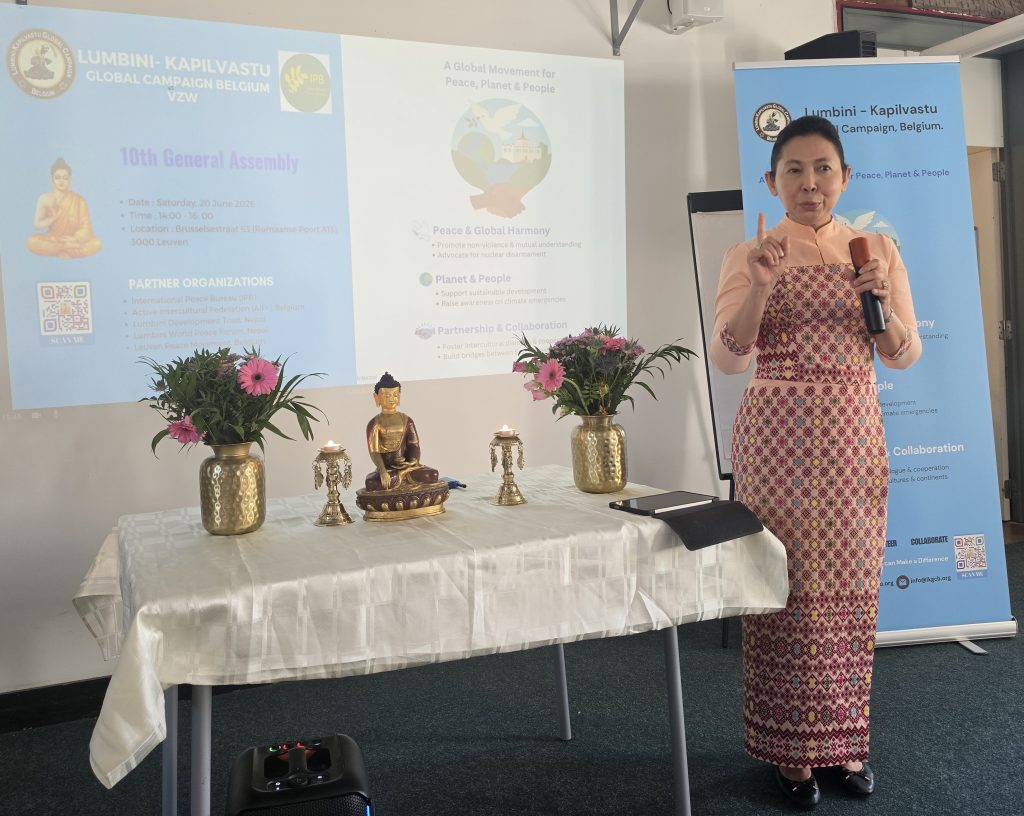
Sharing her personal experience, she explained how meditation helped her manage her health and well-being, highlighting that such practices are essential for everyone—regardless of religion, ethnicity, gender, or nationality. She also expressed her sincere appreciation to LKGCB for the invitation and valued the opportunity to engage with local government representatives and various organizations, emphasizing the importance of such platforms in fostering collaboration for peace.
A Collective Path Forward
The 10th General Assembly concluded with renewed energy and purpose. By bringing together diplomats, civil society, and community organizations, the event reinforced a clear message:
Peace is not merely an aspiration—it is a shared responsibility, built through mindfulness, dialogue, collaboration, and everyday actions.